Hazard labels, placards and marking by hazard class and UN number – compliant for road, rail and sea.
Anyone who produces, stores, packages or transports dangerous goods is subject to clear labeling obligations – whether under ADR (road transport), RID (rail), IMDG (sea) or the globally harmonized GHS (classification and labeling of chemicals). We manufacture the required hazard labels, placards and combination signs to standard, weatherproof and in the prescribed dimensions – for vehicles, containers, packages, IBCs, drums and storage areas.
Every dangerous good carries the characteristic diamond with hazard symbol, the hazard class (e.g. class 2 gases, class 3 flammable liquids, class 8 corrosive substances or class 9 miscellaneous dangerous substances such as lithium batteries), as well as the four-digit UN number and, where applicable, the official shipping name. We manufacture this labeling durably from traffic-white aluminum (e.g. RAL 9016), self-adhesive or as a slide-in sign, in standard sizes (e.g. 250 × 250 mm for placards) or to customer specification.
Diamond-shaped hazard labels in standard sizes for packages, IBCs and drums, as well as large-format placards for vehicles and containers – per ADR/RID/IMDG across all hazard classes, from class 1 (explosives) to class 9 (miscellaneous dangerous substances, e.g. lithium batteries).
Identification panels with UN number and hazard identification number (Kemler code) for tank vehicles and tank containers in road and rail transport, individually made to the specification of the respective dangerous good.
Labeling of containers, drums and storage areas with the nine GHS pictograms (e.g. corrosive, toxic, hazardous to the environment) including signal word – for chemical storage, production and packaging.
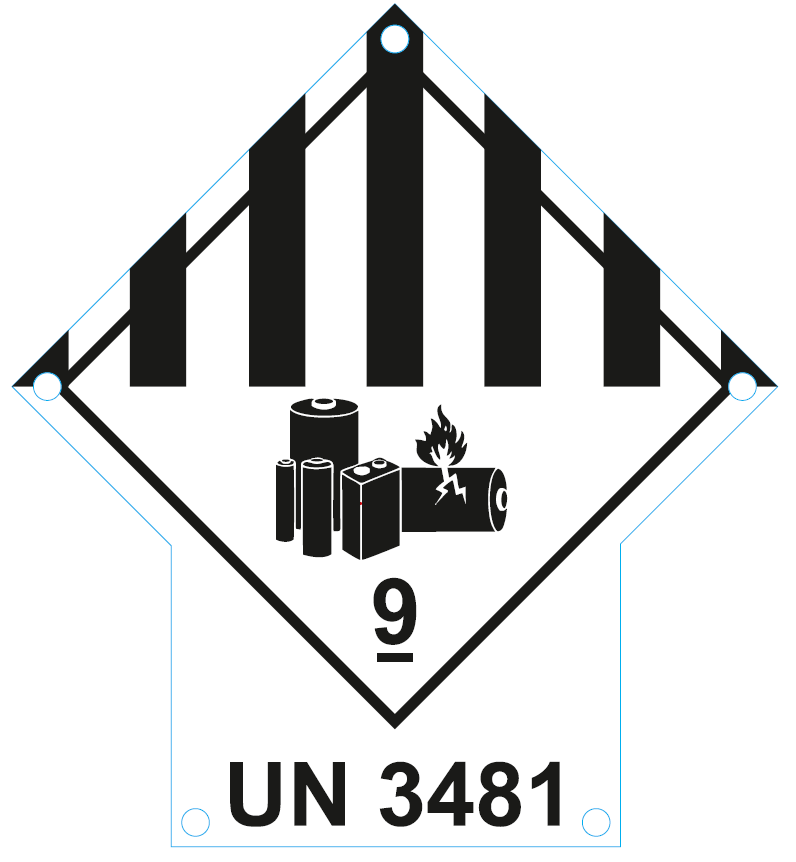
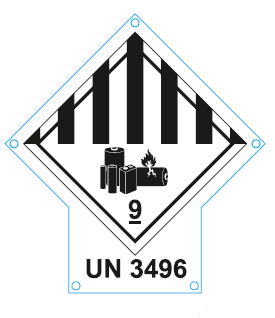
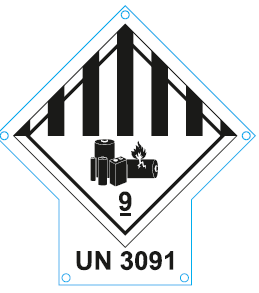
A particularly in-demand area is the labeling of batteries and rechargeable cells classified as dangerous goods – for example when shipping replacement batteries, electronic devices or vehicle batteries. We manufacture the class 9 hazard labels with the characteristic striped pattern and battery symbol for all common UN numbers, for example:
| UN Number | Shipping Name | Class |
|---|---|---|
| UN 1013 | Carbon dioxide | 2 (gases) |
| UN 2800 | Batteries, wet, non-spillable | 8 (corrosive) |
| UN 3091 | Lithium metal batteries contained in or packed with equipment | 9 (miscellaneous dangerous substances) |
| UN 3496 | Batteries, nickel-metal hydride | 9 (miscellaneous dangerous substances) |
We manufacture further UN numbers from the battery and rechargeable-cell range on request as well (including UN 3090 and UN 3480 for loose lithium metal or lithium-ion batteries, UN 3481 for lithium-ion batteries contained in or packed with equipment) – just let us know the matching UN number or your product's data sheet.
Request Battery Hazard LabelsAlready know your product's UN number? Here's an overview of the most important hazard labels – we manufacture every label to standard, in the prescribed size and finish:
UN 1013 identifies carbon dioxide (CO₂) as a compressed gas of class 2.2 (non-flammable, non-toxic) – green hazard diamond with a gas-cylinder symbol. Typical use: CO₂ cylinders, fire extinguishers, beverage and refrigeration systems. We manufacture the matching hazard label weatherproof, in standard size, for cylinders, containers and transport vehicles.
UN 2800 denotes batteries, wet, non-spillable, of class 8 (corrosive) – for example lead-acid batteries in UPS systems, electric wheelchairs or backup power systems. The hazard label shows the corrosion symbol on a black-and-white diamond. We supply the labeling self-adhesive or as a slide-in sign for battery housings, packaging and transport containers.
UN 3090 identifies loose lithium metal batteries of class 9 that are not packed in or with a device – for example when shipping replacement batteries or cells separately. The class 9 hazard label with its characteristic striped pattern and battery symbol is required for air, sea or road shipments. We manufacture it to standard for boxes, pallets and shipping packaging.
UN 3091 applies to lithium metal batteries that are contained in or packed with equipment – for example cameras, watches or measuring instruments with a built-in coin cell. Here too, the class 9 hazard label with battery symbol is required. We supply the matching labeling for shipping boxes and consolidated packaging in standard or custom sizes.
UN 3480 identifies loose lithium-ion batteries (cells or battery packs) of class 9 that are shipped separately – i.e. not inside a device. This covers, for example, replacement batteries for e-bikes, power tools or electronic devices. The hazard label with battery symbol must be clearly visible on every package – we manufacture it to standard and weatherproof.
UN 3481 concerns lithium-ion batteries that are contained in or packed with equipment – for example laptops, power tools or e-bike batteries together with the frame. This is one of the most common UN numbers in shipping electronic devices. We manufacture the class 9 hazard label for boxes, crates and palletized goods, including as a bulk order for entire batches.
UN 3496 identifies batteries, nickel-metal hydride (NiMH), of class 9 – for example battery packs for tools, medical devices or hybrid vehicles. The class 9 hazard label with battery symbol is required when shipping larger quantities. We manufacture the labeling to standard for packaging, containers and load carriers.
Because regulations on dangerous goods and chemical labeling are regularly tightened and enforced, a durable, compliant solution is worth it over makeshift labeling. Whether a single drum or complete warehouse and fleet labeling – we advise you on material, format and the regulations relevant to your industry.
Tell us about your requirement – we'll get back to you promptly with a well-founded assessment of material, process and lead time.
Get in touch